
You design a stunning façade, close the windows and turn the air conditioning up to full power. Even so, at four in the afternoon, that sun-drenched living room turns into an impassable oven. The air chills the room, but the armchair near the window burns your skin.
The Brazilian sun does not forgive poorly specified façades. And the culprit for this discomfort is not the window's lack of insulation, but a completely different physical phenomenon: radiant heat gain.
If you read our guide on what the Uw value is, you know we promised to tell the other half of the thermal story. Well, this is the other half. A high-end window can have the best insulation against air temperature and still cook your living room if it lets the sun's radiation through freely. The solution lies in a single metric that sets the rules in hot climates: the solar factor.
The two halves of the thermal equation
To master the specification of a glass, you need to separate the physics into two boxes: conduction and radiation.
The U-value (insulation) deals with conduction. It measures how fast heat physically leaks through the window. We want a low U-value so the cool air from our AC does not escape, and so the hot blast from outside does not get in.
The solar factor, also known as the g-value (or SHGC — Solar Heat Gain Coefficient), deals with radiation. It measures the exact fraction of the sun's energy that the glass lets through as heat waves.
While Nordic countries often seek glass that lets the sun in to warm the house in winter, the rule in Brazil — especially on façades facing north and west — is the opposite: we need relentless solar control. We want the light, but we reject the heat.
What the solar factor really measures
The solar factor is expressed on a simple scale from 0 to 1 (or from 0% to 100%). The lower the number, the less heat enters your space.
An ordinary, clear single pane has a solar factor of approximately 0.82. That means it lets 82% of the sun's heat in to bake your room. High-end façade engineering works to drive that number down to 0.30 or less.
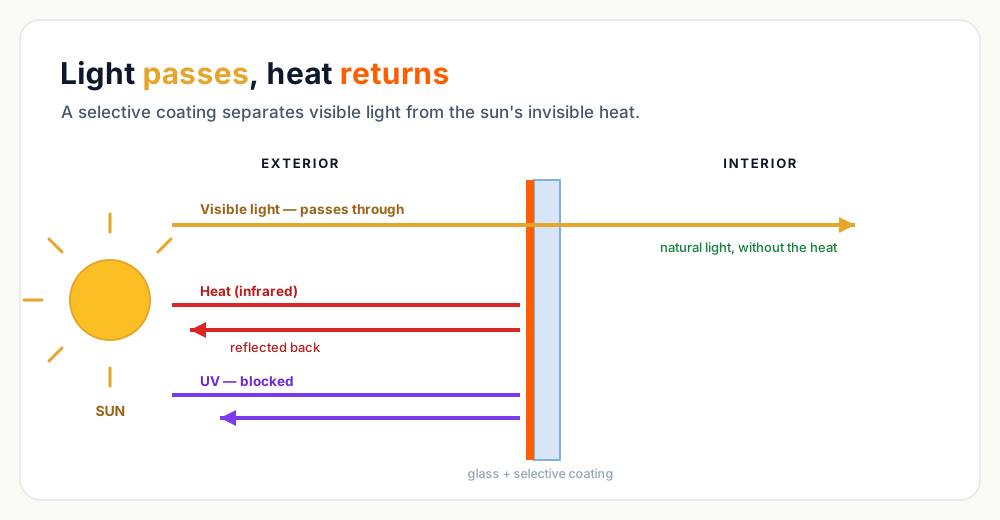
But there is an architectural challenge: if you simply darken the glass to block the sun, you lose the natural light and change the character of the project. This is where the "Holy Grail" of high-end glass comes in: selectivity. Smart glass is "selective" — it blocks the invisible infrared waves (the heat) and lets the visible waves (the light) through.
The anatomy of solar control
To achieve this selectivity and drive down heat gain, high-end engineering layers three fundamental choices onto the same pane of glass.
1. The invisible coating (the great barrier)
The technological masterstroke happens on a microscopic scale, with baths of noble metals applied to the surface of the glass.
- The Low-E standard: Low-emissivity (Low-E) coatings are exceptional for improving overall insulation, and as a bonus they cut solar gain by about 30%.
- Selective glass: This is the ultimate evolution for hot climates. The selective coating is a highly complex Low-E that manages to block almost 60% of the radiant heat without changing the transparency of the window. It delivers maximum light with minimum heat.
2. Colour and aesthetics (the mass filter)
The natural colour of the glass — its mass — sets the starting point for how much energy will pass through. It is a physical and visual barrier.
- Ordinary glass (Clear) and Extra Clear: Ordinary clear glass lets energy through almost freely. There is also Extra Clear, which is treated to remove the iron from its composition, becoming incredibly crystal-clear. It maximises the light coming in and is perfect for shaded façades (such as the south face), but terrible at holding back direct sun.
- Tinted glass (grey/smoke): When we add colour to the mass of the glass, it begins to behave like dark clothing in the sun: it absorbs the radiation. This significantly reduces the solar factor, but there is an immediate architectural trade-off. By using grey-mass glass, you block the heat, but you permanently darken the natural light coming in and alter the colour of your view.
3. The physical barrier of chambers (insulated glass)
The number of glass panes in a window affects not only the insulation against hot or cold air; it also acts as a sequential filter for radiation. When the sun's rays hit double glazing (two panes separated by a gas chamber), the energy has to cross the first pane, the gas and the second pane. The simple act of using double glazing automatically cuts about 14% of the heat compared with a single pane. If we jump to triple glazing, that cut rises to 22%, creating a robust base for the coatings (such as the selective one) to do their work masterfully.
The myth of laminated glass and UV rays
There is a very common misunderstanding in the high-end architecture market: believing that the film in laminated glass helps keep the house cooler. This is a physical myth.
Laminated glass is made of two panes of glass bonded by a super-strong plastic film called PVB. This film is spectacular for safety, for acoustic insulation, and it has a very specific "superpower": it blocks 99% of UV (ultraviolet) rays.
UV rays are responsible for fading and destroying wooden furniture, artwork and expensive fabrics. Protecting the home against them is essential. However, UV rays carry no heat. The radiation that turns your living room into an oven travels through the infrared rays.
The conclusion is simple: PVB protects your floor from fading over time, but it does nothing to lower the solar factor (g). To protect the space from heat, the true barrier will always be the selective coating applied to the glass.
The evolution of comfort in practice
To picture how these technologies transform a space, we can watch what happens to the solar factor (g) of the same window as we apply layers of engineering (reference values):
- The ordinary project: Clear double glazing with no treatments has a solar factor of around 0.71. Excellent at holding the AC in, but terrible under the afternoon sun.
- The technical evolution: By adding a Low-E coating, that number drops to about 0.49. The room already becomes liveable.
- High performance: By swapping the basic Low-E for the selective coating, the solar factor plummets to 0.30. You get a crystal-clear, cool façade.
- Extreme blocking: By combining a grey-mass glass with a selective coating, we reach an impressive 0.19.
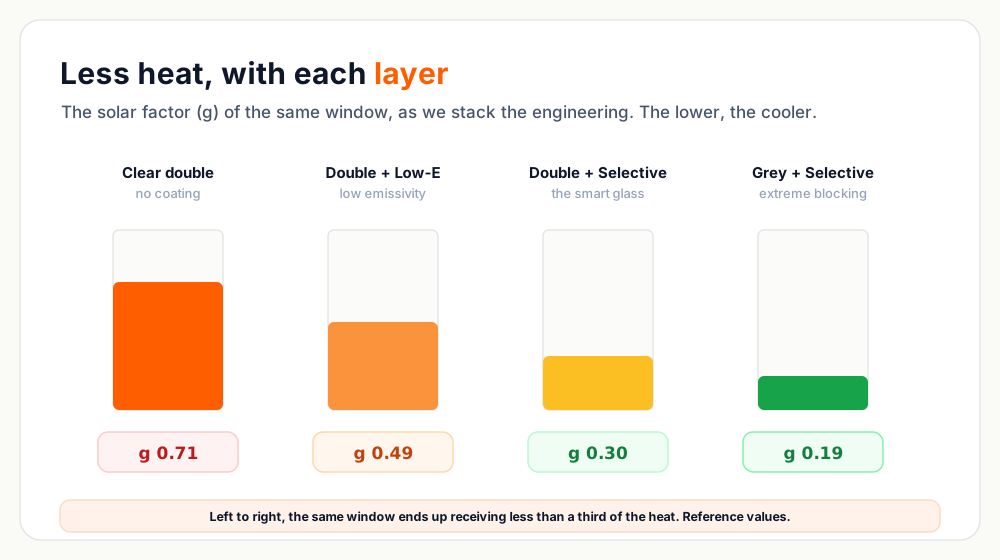
In short: with the correct specification, your space receives less than a third of the original solar heat. The suffocating heat sensation disappears without you losing the panoramic view.
The Aken approach: engineering for the real climate
Working with large glass façades demands understanding that monumental aesthetics lose their meaning if they come paired with discomfort. Solar control (g) is the perfect partner to the thermal break profile. While the thermal break holds the controlled temperature in, solar control stops the sun from destroying that effort.
At Aken Studio, the specification of our windows is not an isolated aesthetic decision. When we design the thermal barriers of a project, the solar factor is calibrated orientation by orientation — guaranteeing maximum transparency on protected façades and relentless heat blocking on the west-facing ones.
Now that the two halves of high-end physics — insulation (U) and the solar barrier (g) — are clear, you hold the key to understanding the supreme building standard. Discover how all these technologies converge in the most rigorous certification on the planet in our article on the decisive role of windows in the Passive House standard.
Thermal Insulation
- 1The anatomy of comfort: what the Uw value means in the thermal insulation of windows
- 2The metal that gives away your comfort: the engineering behind the Thermal Break in aluminium
- 3The thermal frontier: why the Warm Edge is the detail that changes everything in double glazing
- 4Light without heat: how the solar factor (g) defines the comfort of glass façades
- 5The summit of efficiency: what the Passive House standard is and why the windows decide the game