
Imagine a house where the temperature in absolutely every room is always perfect and stable. There are no cold surfaces near the glass, no draughts under the doors, and the indoor air is renewed and fresh 24 hours a day. And the most impressive part: the need to switch on the air conditioning or the heater to keep this oasis is practically nil.
This level of absolute control is not magic; it is rigorous engineering. The name of this concept is Passive House (or Passivhaus, in the original German). It is the world's most demanding building standard for comfort and energy efficiency. And, in the whole architecture of a Passive House, there is a single component that tends to dictate whether the project will be a success or a failure: the windows.
What really is a Passive House?
Contrary to what the name suggests, Passive House is not an architectural style nor a brand. It is a performance standard. Developed by the Passive House Institute, in Germany, it rests on a very simple premise: it is far smarter to design an envelope (walls, roof, floor and windows) that does not let energy escape than to install gigantic machinery to compensate for the house's thermal leaks.
The numbers are superlative. A building certified to the standard can consume up to 90% less energy for climate control than a conventional construction. Comfort comes to be solved by the design of the house itself, "passively".
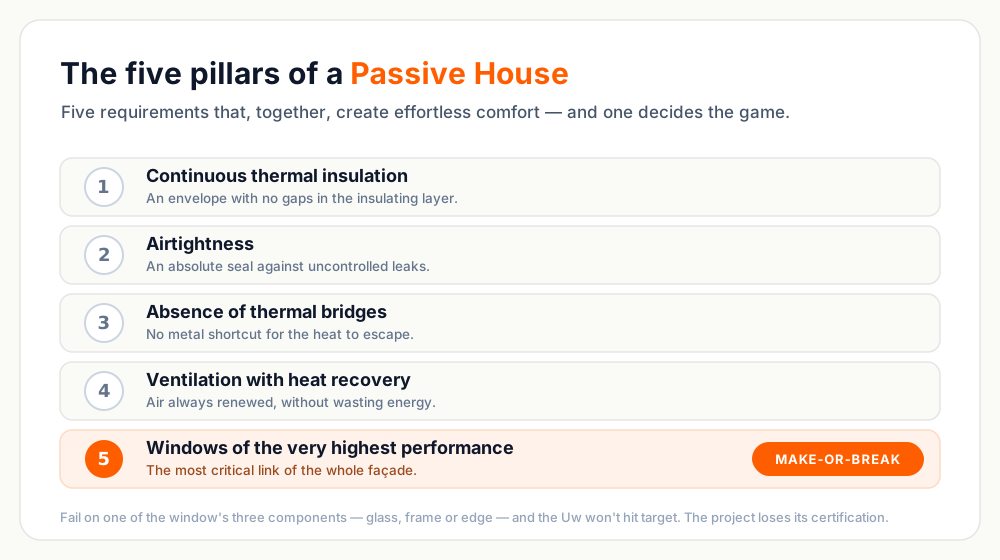
To reach this technical utopia, the project has to rigorously obey five fundamental principles:
- Continuous thermal insulation.
- Airtightness — an absolute seal against the uncontrolled entry or exit of air.
- Absence of thermal bridges.
- Mechanical ventilation with heat recovery.
- Windows of the very highest performance.
The breaking point: windows as protagonists
Of these five pillars, the windows are, by far, the most critical link. They take on a dual and complex function. On the one hand, structurally speaking, the window will always be the most thermally fragile part of the façade. On the other, the glass works as the home's great collector of solar energy.
For the house to retain its temperature, the Passive House standard sets implacable targets. In reference climates, the whole window (once installed) is required to reach a Uw value — the thermal insulation of the window as a whole — equal to or below 0.80 W/m²K. But hitting that target demands that no technology be left out:
- You need high-performance insulated glass.
- The frame needs a thick, structural thermal break.
- The edge of the glass requires Warm Edge spacers to cancel the linear loss of heat.
If just one of these three elements fails, the window does not reach the number — and the entire project loses its certification.
Passive House in Brazil: inverting the logic of the cold
When we talk about European standards, the image that comes to mind is protecting the house against the glacial winter. But how does this translate to a country with a tropical climate and intense summers, like Brazil?
The principles of physics are exactly the same, but the priority is inverted. In Brazil, the greatest challenge of energy efficiency is not keeping the heat inside the house, but rather stopping the sun's heat from getting in, while keeping the cool air from the AC in there without waste.
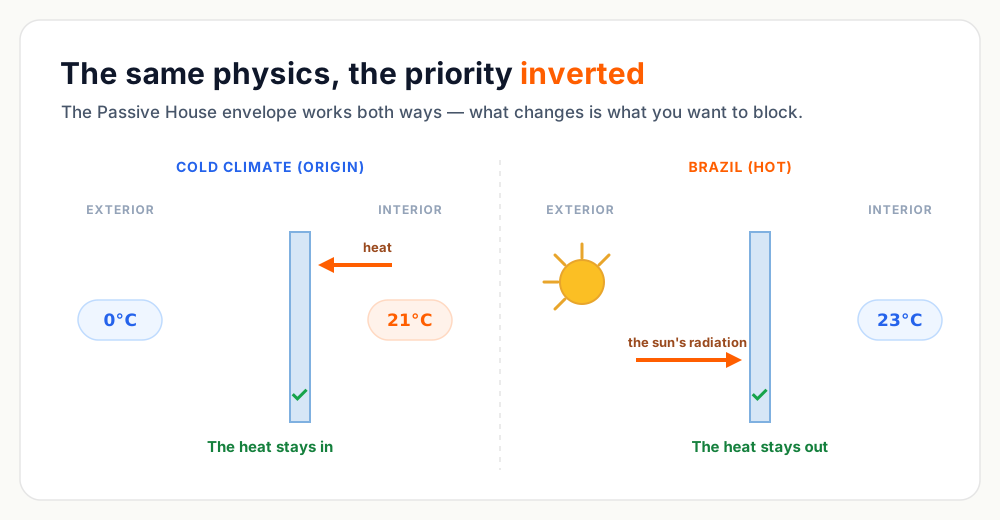
The strategy shifts focus:
- Radiation before conduction. As we detailed in our guide on the solar factor (g), there is no point in perfect thermal insulation if the glass lets the sun's radiation bake your living room. The use of solar-control coatings (such as Selective glass) becomes mandatory to block the infrared and cancel the greenhouse effect without losing natural light.
- Maximum airtightness. This is where the magic happens. With hermetically sealed windows, the climate-controlled air does not escape through the gaps and the suffocating humidity from outside does not get in. Your air conditioning starts working at a minimum, only for maintenance, brutally cutting the energy bill.
What makes a window "certifiable"
It is not enough to buy an excellent window. In the Passive House universe, the installation is assessed just as much as the engineering of the product.
A "certifiable-grade" window is one designed to receive a perfect hermetic seal at the interface with the masonry — the wall opening. If there is a micro-leak of air between the aluminium frame and the plaster, the excellence of the glass and the profile is invalidated. The system and the installation go hand in hand.
The Aken approach: closing an ecosystem
At Aken, we design our lines knowing that the aesthetics of a minimalist façade only hold up when supported by engineering with no concessions. Our windows are designed to reach the level of performance that rigorous standards like Passive House demand. We combine a structural thermal break, precise solar control and an airtight seal to create a system that holds the numbers your project needs.
With an understanding of the Passive House standard and of all the components that support it — the physics of air, the barrier against the sun, the break in conduction in the aluminium and the warm edge in the glass —, we close here the cycle of thermal comfort in high-end façades. You now master the metrics that guarantee the perfect temperature of your project.
But monumental comfort has a second dimension. When you specify a window with the level of airtightness and robustness the Passive standard demands, you prepare the ideal base to solve architecture's next great luxury: silence.
The physics that shields the temperature is the foundation of the physics that blocks noise. Watch out for our next series of articles, dedicated entirely to the secrets of acoustic insulation — where we will show how to turn the airtightness of the passive standard into absolute silence. Coming soon, right here.
Thermal Insulation
- 1The anatomy of comfort: what the Uw value means in the thermal insulation of windows
- 2The metal that gives away your comfort: the engineering behind the Thermal Break in aluminium
- 3The thermal frontier: why the Warm Edge is the detail that changes everything in double glazing
- 4Light without heat: how the solar factor (g) defines the comfort of glass façades
- 5The summit of efficiency: what the Passive House standard is and why the windows decide the game