
Picture the scene: you're in your living room. The day is perfect outside. You walk up to what looks like a single sheet of glass wall, turn a solid handle and, with a two-finger touch, push a glass panel that weighs as much as three adults. It glides without resistance, without a sound, fusing the inside of your home with the terrace.
An entire wall has simply moved out of the way.
The desire to dissolve the boundary between inside and out is what drives contemporary high-end architecture in Brazil. We want the sea breeze, the view of the garden, natural light flooding the room. The problem is that, historically, very large sliding doors charge a high price: they tend to be too heavy to operate and, ironically, too fragile against wind, noise and heat.
The Lift & Slide technology was created to break that deadlock. It's the mechanism that lets whole façades open without sacrificing the performance of a closed wall. And at the level of scale and precision Aken operates at, it's a technology you'll hardly find on the Brazilian market.
But how, exactly, does a panel of hundreds of kilos move without effort?

The limit of ordinary sliding doors (and the friction dilemma)
To understand the genius of Lift & Slide, we need to look at the fundamental flaw of the traditional Brazilian sliding door.
An ordinary sliding door glides, all the time, over its own rollers and tracks. It has to brush against the brushes or weatherstripping — where they exist — along the entire path. Here an unavoidable conflict of basic physics is born: if the door seals well, friction is enormous and it becomes heavy; if it slides easily, it's because there are gaps, and wherever the wind passes so does the noise and out goes the air conditioning.
As architects began drawing ever larger and heavier glass, that geometric flaw collapsed. An ordinary sliding door, on reaching monumental proportions, becomes a wall that whistles in the wind, judders, and demands your whole body's strength to be dragged.
Weight became the enemy. Lift & Slide engineering turns weight into an advantage.
The mechanism: float to move, anchor to seal
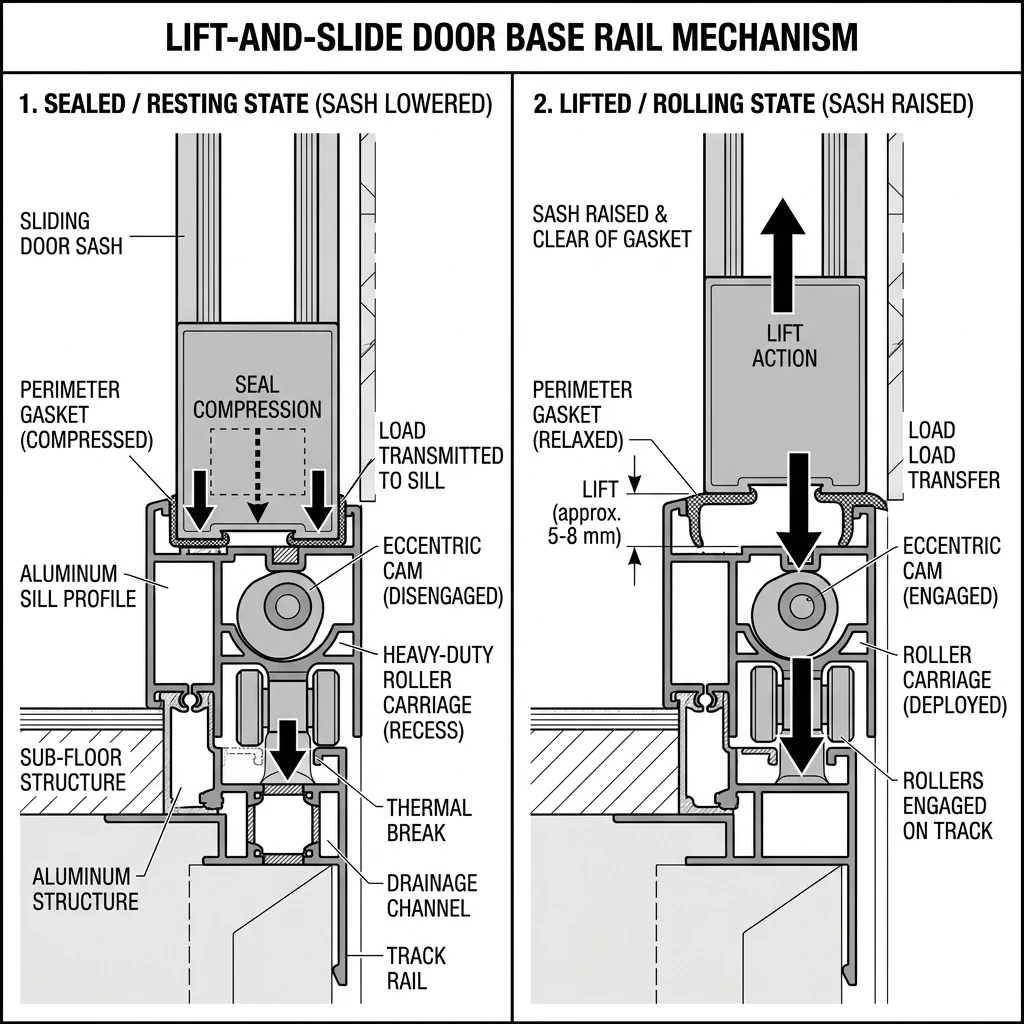
The Lift & Slide trick happens behind the scenes, invisible to the eye, triggered by turning the handle. The premise is elegant: the door has two completely independent states — one for movement and one for sealing.
With the handle pointing down, the door is at rest. The colossal weight of the glass and aluminium presses the frame against the floor and the sides. In this state, it doesn't touch the rollers: it is mechanically locked, crushing the weatherstripping (the perimeter gaskets). It is, for all purposes, a fixed wall.
The transformation happens when you turn the handle 180 degrees.
A precision cam — a cam, the same kind of part that operates the valves in a car engine — hidden inside the profile is triggered. That mechanical lever multiplies the force of your hand and lifts the entire door structure by a few millimetres. The sash releases from the seals and its whole weight is transferred to the robust roller carriages built into the base.
The drag friction plummets. The hermetic seal is temporarily undone. Now, resting on machinery designed to absorb hundreds of kilos, a 200 to 300 kg panel slides with the lightness of a feather.
You guide it to the desired position and turn the handle back. The door "lands" back into the rest state: it locks, crushes the seals again, and the room becomes an isolated chamber once more.
Monumental spans and the aesthetics of the invisible
Because friction stops being a problem during movement, size restrictions simply disappear.
It's this paradigm shift that lets colossal spans be built, where a single sheet of glass runs floor to ceiling. Lift & Slide is the exclusive territory of high-performance aluminium systems — polymers like PVC don't have the structural rigidity to support panels of that magnitude without deforming or requiring reinforcements that ruin the minimal aesthetic (a difference we detail in our PVC vs Aluminium comparison).
With the weight held by engineering, not by your arm, the aluminium frames can become slim. The view is maximised. When the doors overlap or retract into a wall, the transition between the dining room and the outdoor gourmet area loses its steps, its trips and its visual interruptions. The window gets out of the way.
The hermetic seal that isn't lost at scale
Having a home with a glass façade in Brazil can't mean living in a greenhouse — or in a noisy environment.
The real differentiator of a Lift & Slide system in a luxury residential project isn't only how big the door can be, but what happens when it closes. Because it doesn't drag on the seals but "lands" onto them under its own massive weight, the seal it generates is hermetic.
It's this static perimeter compression that ensures the thermal insulation (the Uw value — the lower, the better) and the silence (the Rw index) survive the monumental scale. The chaos of traffic on the avenue outside, the burst of late-afternoon rain and the overheated summer air run up against that barrier, letting the home's climate control operate at maximum efficiency.
Monumental glass, without the wind whistling through the gaps.
The engineering Brazil rarely sees
Sliding 300 kg of glass with a touch is not magic. It's the result of brutal tolerances and precision machining: the perfectly levelled bottom track, the high-capacity rollers that don't deform under constant load, the EPDM seals that don't dry out over time.
The national market tends to avoid this technology because it demands a level of installation precision, machinery and profile quality that doesn't fit cost-focused mass production. The vast majority of heavy doors sold as "high-end" in Brazil still rely on constant friction — they're heavy today and will be jammed five years from now.
At Aken, Lift & Slide technology isn't an extravagance, but the only acceptable mechanical foundation when designing monumental spans. The system is designed as a single organism: the aluminium profile, the thermal break, the lifting hardware and the load of the double or triple glazing are all calculated together.
The result is the brand's tactile signature: the monumental weight of the product, tamed by absolute lightness in daily use.
A wall of glass that moves with two fingers and seals the room as if it weren't even there.
The next step for your project
Discover the precision technology for casement windows: Tilt & Turn — the window that opens two ways.
Understand how the hermetic seal blocks the sun's heat: the Uw value and the science of thermal insulation.
See why aluminium is the only choice for monumental systems in our buying guide: the art of choosing the right window.
Frequently asked questions
What is a Lift & Slide door?
It's a large-span sliding door with a lift-and-slide mechanism: turn the handle and the whole sash rises a few millimetres, releases from the weatherstripping and begins to roll on roller carriages — which is why a 200–300 kg panel slides with two fingers. When you lock it, the sash 'lands' back down and seals like a fixed wall.
What's the difference between Lift & Slide and an ordinary sliding door?
The ordinary sliding door drags over its seals the whole time: if it seals well, it's heavy; if it slides easily, it has gaps where noise and heat pass. Lift & Slide separates the two states — it floats on rollers to move and lowers onto the gaskets to seal — so it's light to operate AND hermetic when closed, even in monumental spans.
How much does a Lift & Slide door weigh, and why does it slide so easily?
A single glass panel in high-end systems typically weighs 200 to 300 kg. It slides effortlessly because the cam mechanism provides all the mechanical advantage to lift the sash onto high-capacity roller carriages — the drag friction against the seals is eliminated, leaving only rolling.
Can you make a Lift & Slide door in PVC?
Not at a monumental scale. PVC doesn't have the structural rigidity to carry panels of hundreds of kilos without deforming or requiring reinforcements that thicken the profile and ruin the slim aesthetic. Colossal glass spans are the territory of high-performance aluminium systems.
Technologies
- 1Tilt & Turn: the window that opens two ways (and why Brazil doesn't know it yet)
- 2Lift & Slide: the engineering behind monumental walls of glass
- 3Argon gas vs. dry air: what fills the glass cavity (and why it changes everything)
- 4Cavity width: why a 'wider' double-glazed unit doesn't always insulate more
- 5Double vs. triple glazing: when triple actually pays off in Brazil