
You will live with your project's windows for the next two or three decades. They will be there on every scorching afternoon, every cold dawn, every noisy night and every sunrise. And yet most people spend more time and energy choosing the living-room sofa than deciding the windows of the house.
This is the paradox of high-end architecture. Windows are, by far, the most complex element of a home's envelope. They define thermal comfort, silence, the light coming in and security. But when it comes time to close the deal, the market tends to reduce an engineering decision to a simple off-the-shelf purchase.
Buying a window is not choosing a product; it is commissioning a system. And to make sure that system delivers the quality of life your project demands, you need to know how to read between the lines of a quote — and to invert the way the market usually compares products.
The two wrong criteria (and why everyone falls for them)
When a window quote reaches a client, the eye goes straight to two things: the finish (the colour and look of the profile) and the final price.
Both matter, of course. But they are the outcome of a series of structural decisions, not the decisions themselves. Price, in particular, is a consequence — and in a moment you will know exactly what is being charged inside that number, and why the cheap window is cheap.
A window with an impeccable paint job but a profile that channels the heat of the street indoors, and a seal that lets the wind whistle through, is an expensive mistake that only looks like a win on installation day. Focusing exclusively on appearance and price is the recipe for living with the air-conditioning on full and your patience on empty.
What actually decides your comfort: the new order
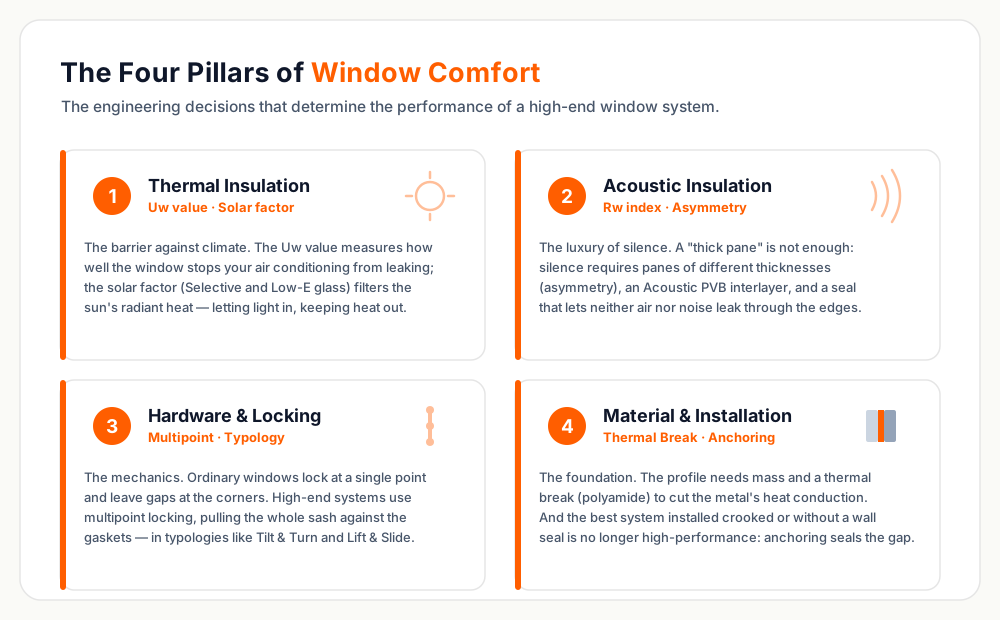
To read a quote like an expert, you need to reorder your priorities. The comfort of a home is decided by these four engineering pillars:
1. Thermal insulation: the barrier against the climate
Will you roast in the afternoon sun, or manage to keep the room cool? The answer is not in the thickness of the glass, but in two precise metrics. First, the Uw value, which measures how well the window stops your air-conditioning from leaking out. Second, the solar factor — the treatment on the glass (like Selective glazing) designed to let the light in while keeping the sun's radiant heat outside.
2. Acoustic insulation: the luxury of silence
Will the noise of the avenue or the neighbour's dog get into your home? For that, asking for "a thick pane" is useless. Silence demands asymmetry in the glass panes, the presence of a special interlayer (Acoustic PVB) and, fundamentally, a window that lets no air leak through the edges. Silence is measured by the Rw index.
3. Hardware and closing: the mechanics
How does the window open and, above all, how does it close? Ordinary windows close at a single point, leaving gaps in the corners. High-end windows use multipoint closing, pulling the whole sash against the gaskets, and adopt high-engineering typologies such as Tilt & Turn and Lift & Slide. The weight and the glide of the window reveal its true quality.
4. Material and installation: the foundation
The skeleton of the window and the way it is anchored into the wall decide whether the system lasts thirty years or warps in three. The profile needs mass and thermal-break technology (Thermal Break). This is where the classic debate over what to use comes in: PVC or aluminium? And remember: the best window in the world, installed crooked or without a proper wall seal, stops being a high-performance window.
Double or triple glazing: the practical decision
When you look at the quote, the number of panes is the most common doubt. Set the technical language aside for a moment and think in practical terms:
When to buy double glazing: It is the new standard for anyone after real comfort in Brazil. It solves almost 90% of the problems of urban homes and country houses. If you want to run the air-conditioning without wasting energy, block the afternoon sun and dampen the normal noise of the city, double (insulated) glazing is the way.
When to buy triple glazing: It is the choice for extreme cases or maximum-efficiency projects. You need triple glazing if you are pursuing a rigorous sustainability certification (like Passive House), if the window sits in a region facing intense winters (like the highlands of the South), or if you live next to an airport and need a formidable acoustic barrier.
That is the decision at the moment of purchase. The physics behind it — why the gas and the distance between the panes change everything — is the subject of a coming chapter in this series.
How to read a quote like an expert
Now that you know the pillars, you can see that comparing the price of two "2×2m sliding windows" from different suppliers is almost always an unfair comparison.
To separate the high-end suppliers from the ordinary resellers, ask direct questions about the fine print of the quote:
- Does the profile have a Thermal Break?
- What is the exact glass build? (Steer clear of anyone who just says "double glazing." Insist on knowing whether there are Low-E coatings, a warm edge, and the exact thicknesses.)
- What are the thermal (U) and acoustic (Rw) figures of the assembled system?
- Is the window made to generic sizes, or was the profile engineered to withstand the winds of my region and the exact size of my wall?
The gulf between off-the-shelf and made-to-measure
This is where the idea of "high-end" earns its real meaning. It is not luxury for luxury's sake. It is engineering with a purpose.
A window system cannot come from a ready-made catalogue because no two houses are alike. The bedroom window that takes the scorching afternoon sun cannot have the same glass build as the bathroom window facing south. The monumental six-metre span of the living room demands aluminium reinforcements the utility-room window does not need.
The off-the-shelf window is an average. It tries to serve every scenario and, for that reason, is inefficient in the vast majority of them. The made-to-measure window is designed around the specific needs of each opening.
The right time to ask for the quote: alongside the project
Here is the mistake that costs the most — and almost no one sees it in time: leaving the windows for last. The market standard is to treat the window as a finishing item, quoted in the final weeks of the build, when the openings are already done and the architect has already delivered the project. By then, you are no longer choosing the best window: you are trying to fit some window into the hole that was left.
The quote for a high-end window needs to sit on the design table, next to the architect. It is during the project that you decide the width of the slab over the sliding span, the position of the sub-frame, the depth of the wall that will receive the profile, the sizing of the monumental span that only a structurally reinforced system can carry. Bringing this conversation forward is what turns a six-metre wall of glass from a render fantasy into a window that actually opens, seals and lasts.
When the window comes in early, the project shapes itself to it and it to the project. When it comes in late, someone will have to give — and the one who gives is always comfort.
The Aken approach
At Aken, we don't sell a window. We design the system. The structurally thermally broken profile, the individual choice of each pane (solar and acoustic factor), the multipoint hardware and the precision of the installation are thought through together for your project. That is why you don't choose our window on looks alone; you choose it for the guarantee of comfort.
You now have the map to assess any proposal on the market. And if your decision is already made — if it is time to move from study to action — the next step is the most concrete of all: how to measure the opening correctly to replace your windows, the first measurement that separates a flawless installation from one full of gaps.
Still unsure about the foundation of the façade? Break down the question that follows 10 out of 10 projects in our guide on PVC or aluminium — which to choose and why, and understand exactly what justifies the price of a high-end window.
Frequently asked questions
What really matters when buying a high-end window?
More than the glass brand or the profile thickness, what decides comfort is the performance of the complete system: thermal insulation (Uw), acoustic insulation (Rw), the quality of the sealing and the precision of the made-to-measure fit. A serious quote states these metrics.
How do I read a window quote like an expert?
Look for the numbers that reveal the system, not just the price: the Uw (thermal), the Rw (acoustic), the glass type (double or triple, with or without acoustic lamination) and whether the profile has a thermal break. The absence of this data usually signals an off-the-shelf product.
Is triple glazing worth it over double glazing?
It depends on the project. Triple glazing improves thermal and acoustic insulation but is heavier and more expensive. In many cases a well-specified double glazing unit, with acoustic lamination and argon gas, already solves the problem; triple glazing is justified in more extreme situations.
When should I request the window quote?
Ideally alongside the architectural design, not at the end of the build. Windows affect openings, structure and the thermal and acoustic performance of the space. Specifying them early avoids rework and lets you size the right system for each opening.
The Art of Choosing
- 1How to buy high-end windows and doors: the decision guide
- 2How to measure the opening to replace your windows
- 3PVC or aluminium: which window to choose (and why)
- 4What justifies the price of a high-end window