
Sooner or later, every high-end project reaches this fork: PVC or aluminium?
If you search online, you will find answers that are absolutely certain and perfectly contradictory. The reason is simple: the vast majority of those articles were written by someone who makes only one of the materials and needs to convince you the other is a terrible idea.
We are the manufacturer, and our focus is high-performance aluminium. But engineering does not allow favouritism. To choose with confidence, you need an honest balance sheet of where each material shines and, above all, where each material loses.
In this article, we will ignore the sales pitches and look at the numbers and the physics of each profile. And we will start by breaking the market's biggest rule: admitting where our direct competitor comes out ahead. If you are still assembling the full map of the decision, the guide on how to buy high-end windows is the starting point — this one is the chapter on the material.
What each material is at its core
Before comparing them, you need to understand the nature of each one.
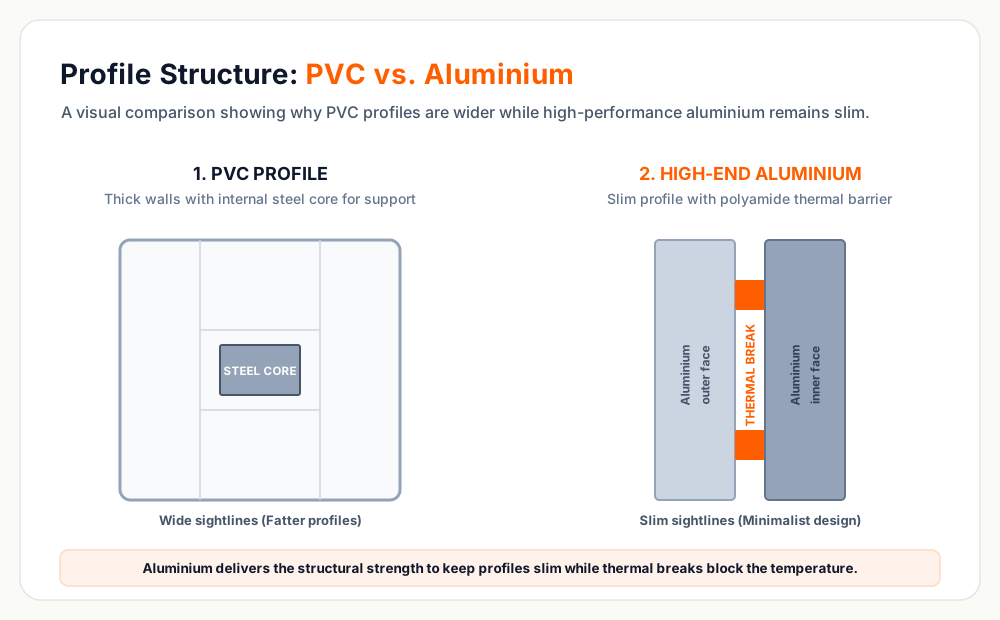
PVC: a rigid polymer (plastic). Its interior is not solid; it is designed with several hollow chambers and, almost always, requires a steel core inserted inside so it does not warp. Its essence is to be an excellent insulator.
Aluminium: a pure structural metal. It is extruded into slim, exact, unshakeable profiles. Its essence is strength and architectural precision.
Where PVC genuinely wins
Let's give credit where it is due. PVC has two incontestable natural advantages, and ignoring them is a technical error.
The first is raw thermal insulation. As we detail in the guide on the Uw value, the frame is the bridge linking the outdoor climate to the indoor one. PVC is, by nature, a terrible conductor of temperature. If you take an ordinary PVC profile and an ordinary aluminium profile, PVC wins comfortably. It is a fantastic thermal barrier that does not "sweat" on very cold days.
The second is low maintenance in basic scenarios, paired with a very competent baseline acoustic insulation thanks to the density of the material.
For projects where the absolute priority is pure thermal insulation alone, with no major structural demands, PVC is a legitimate and excellent answer.
Where aluminium genuinely wins
If PVC is the king of temperature, aluminium is the king of architecture. And it wins on fronts where plastic simply hits its physical limit.
The first victory is aesthetics and minimalist lines. Because aluminium is absurdly rigid, the frame does not need to be thick to hold large panes of glass. The result is what architects call slim sightlines: lots of light, lots of glass and almost no frame. The PVC profile, needing more mass and an internal steel core so it does not break, is invariably fatter and heavier to the eye.
The second victory is monumentality (the large spans). If you dream of sliding doors that run from floor to ceiling, weighing hundreds of kilos, gliding open with the push of a finger (the famous Lift & Slide system), aluminium is the only path. PVC warps under that kind of pressure in large formats. Aluminium delivers dimensional stability that lasts decades.
The third victory is freedom of colour. Aluminium profiles can be painted (electrostatic paint) or anodised in any colour imaginable, with brutal resistance to degradation by the sun. Coloured PVC (usually made by laminating films) suffers under Brazil's aggressive ultraviolet radiation over the years.
The thermal break: how aluminium closed the thermal gap
"Fine, aluminium is stronger and more beautiful. But what about the thermal insulation PVC wins?"
This is the great turning point of the modern window. Because aluminium conducts heat, high-end engineering created the Thermal Break. It is a structural polyamide barrier inserted exactly in the middle of the aluminium profile. It cuts off the express lane for heat. The metal outside never touches the metal inside.
With the Thermal Break, a high-end aluminium frame comes impressively close to PVC's thermal territory. To be brutally honest: in the cold of the laboratory, a top-of-the-line PVC can still hold a very slight thermal edge over aluminium with a thermal break.
But the question you should ask your project is this: do you prefer a window with marginally superior insulation, but with thick edges and size restrictions — or a window that guarantees your thermal comfort while allowing immense spans and minimalist lines?
The price myth: why "cheaper" is an illusion
Historically, the market coined a rule: "aluminium is the dream, but PVC is cheaper." And this is where the decision tends to end for many clients. But our engineering ran a real test to prove that rule is out of date.
We compared the cost of four openings using premium "off-the-shelf" PVC windows (from a large building-supplies store in São Paulo) against Aken's made-to-measure manufacture. The result, with São Paulo taxes, no freight and no installation:
- Off-the-shelf PVC: R$ 14,336
- Made-to-measure Aken: R$ 13,145
We won the total budget. But the shocking point is not the financial difference; it is that the comparison is not fair.
The "off-the-shelf" PVC windows used plain or common laminated glass, with no insulating gas specified. The Aken solution that beat the price delivered insulated (double) glass, tempered, with a dry-air chamber and thermally broken profiles.
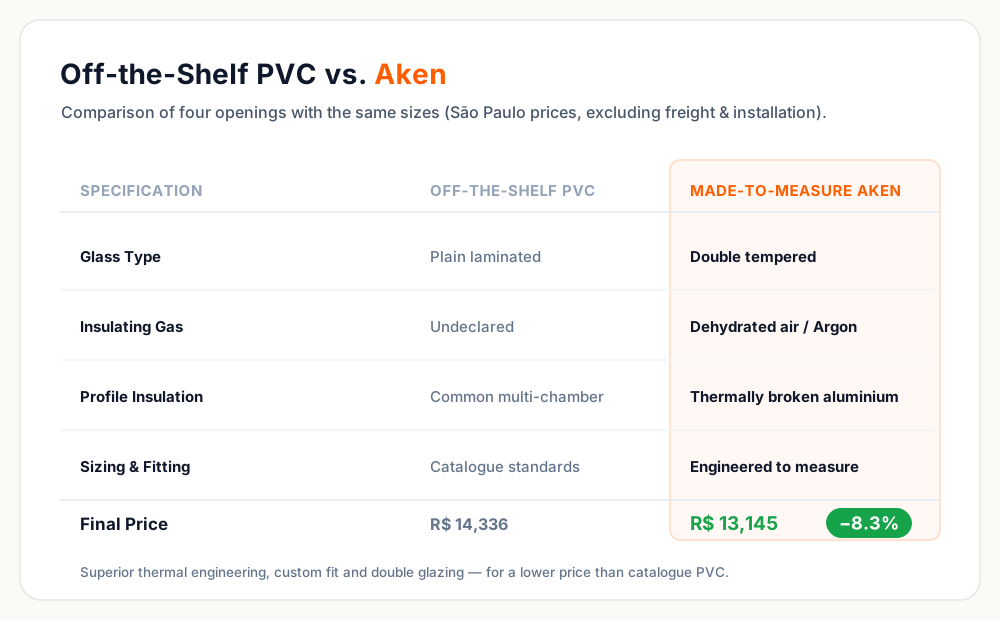
In other words: a made-to-measure aluminium window, with infinitely superior engineering, delivered for a lower final price than the plastic option sold from a catalogue. If you are only quoting a small bathroom window, off-the-shelf PVC will always be cheaper. But the moment we are talking about a real project, with considerable square metres and a need for performance, the price myth collapses.
The decision: what does your project demand?
With price out of the equation, the choice stops being a negotiation and becomes a matter of fitting the project.
If your goal is acceptable thermal insulation in modest, traditional openings, PVC is an excellent answer. It does what it promises.
But if you are building architecture — if your project demands immense panes of glass, slim lines, heavy sliding systems and durability for the next generation, without compromising temperature — then aluminium with thermal engineering is the foundation you are looking for.
Our approach
At Aken Studio, we did not choose aluminium by chance. We chose it because it is the only material that does not force us to choose between monumental beauty and thermal efficiency. And the confidence to tell you where the other material wins is exactly what a real specialist does — honesty about PVC is our stance, not a courtesy.
Now that the choice of material is settled, you are ready to look the budget in the eye. The next step is to understand what justifies the price of a high-end window — what is really built into that figure and why it pays for itself, every day, in continuous comfort.
Frequently asked questions
PVC or aluminium: which window is better?
There is no absolute winner — it depends on the project. PVC insulates well by nature and costs less in simple profiles. Aluminium allows larger spans, slimmer lines and a high-end finish, and with a thermal break it reaches the same insulation level. The choice is about what the project demands.
Does a PVC window insulate better than aluminium?
PVC is an insulator by nature, while bare aluminium conducts heat. But aluminium with a thermal break cancels that disadvantage and reaches equivalent thermal performance. Comparing PVC with aluminium that has no thermal break is not a fair comparison.
Why do people say PVC is cheaper?
It is a partial myth. In simple profiles PVC really does cost less, but in high-end windows, with the same level of glass, sealing and performance, the difference shrinks and sometimes disappears. The 'cheaper' claim usually compares products from different categories.
When should I choose aluminium over PVC?
When the project calls for large spans, heavy sliding sashes, minimalist lines or a refined architectural finish. Aluminium has the structural strength for that; PVC, being more flexible, needs bulkier and more visible profiles to span the same openings.
The Art of Choosing
- 1How to buy high-end windows and doors: the decision guide
- 2How to measure the opening to replace your windows
- 3PVC or aluminium: which window to choose (and why)
- 4What justifies the price of a high-end window