
It is a classic moment in the building of any home of excellence. You receive the quotes and lay them side by side on the table. On one side, a generic proposal from a building-supplies store. On the other, the quote from a made-to-measure window studio. The gap in figures is frightening, and the question that surfaces in your head is immediate and perfectly fair: "Is it worth paying all that for an aluminium window?"
The short answer is: no. It would not be worth paying that much more for the same window.
What the quote cannot explain — and what the market frequently fails to communicate — is that you are not comparing the same objects. The word "window" is only a category. An ordinary catalogue window and a high-end architectural system share the same name but belong to completely different engineering universes.
To know whether the investment is worth it, you should not ask why the high-end project costs more. You should ask what the cheap project left out to manage to cost so little. If you are still assembling the whole decision map, the guide on how to buy high-end windows organises it all — this one is the chapter on price.
What engineering builds into the price (the substance)
The "luxury" of a premium window is not in a logo or an abstract status. The luxury is in the physics and the components the cheap manufacturer had to cut to win the price war.
When you pay for a monumental window system, your investment is being allocated across these invisible pillars:
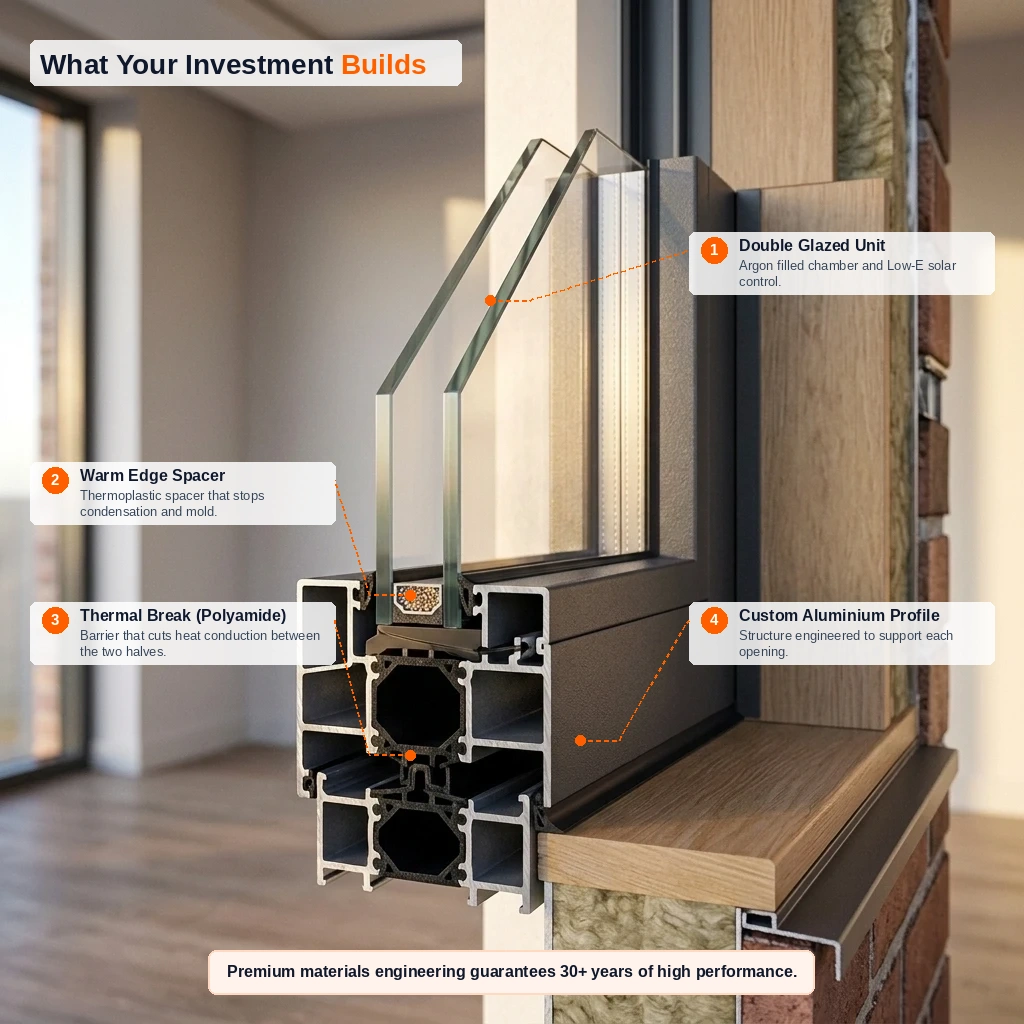
1. Glass that thinks (the insulated unit)
In the off-the-shelf market, glass is just a barrier against the wind. In the high end, glass is a selective climate filter. The premium quote includes double or triple insulated glazing with argon gas and, crucially, Low-E or Selective coatings. This engineering lets the sunlight brighten your room without the radiant heat roasting your furniture — it is what secures a good Uw value and makes you spend less energy on air-conditioning.
2. The edge that does not mould (the warm edge)
Have you ever seen windows that "sweat" in the morning and grow a line of black mould around the glass? That happens because the factory cut a corner and used ordinary aluminium spacers to separate the panes. The window of excellence uses advanced thermoplastic spacers (Warm Edge), keeping the edge of the window always dry and warm.
3. The end of the thermal leak (the structural break)
Pure aluminium is an express lane for heat and cold. As we detail when comparing PVC and aluminium, basic frames hand the temperature of your room out to the street. The premium value builds in Thermal Break technology: a polyamide barrier at the core of the profile that cancels the metal's conduction. The consequence? Your air-conditioning stops leaking and the energy bill plummets.
4. The exact millimetre (the made-to-measure fit)
The off-the-shelf window is an average; it is forced to fit the hole in your wall. A made-to-measure window is engineering applied to your site. It is sized to withstand the exact wind load of your floor, with the profiles reinforced where the span demands and slimmed where the architecture allows. And all of this starts with the right measurement — which is why measuring the opening correctly is the first act of engineering on the build.
5. The precision of a safe (the hardware and the seal)
The difference between a profile that glides smoothly with hundreds of kilos of glass (like the Lift & Slide system) and one that jams on the track is in the hidden machinery. Low-value windows use simple latches that leave gaps in the corners. Serious windows use multipoint locking, which crushes the closing against thick EPDM gaskets, creating a true vacuum against draughts of wind and street noise.
The invisible cost of "cheap" (the bill arrives every day)
The problem with generic windows is that the financial relief only happens on the day you pay the invoice. From that moment on, the bill for what was saved starts being charged daily.
You pay on the electricity bill, with the air-conditioning running flat out because the window does not hold back the afternoon sun. You pay in quality of life, waking up irritated by the street noise the gap did not block. You pay in comfort, unable to sit near the glass façade on hot days. And, invariably, you pay in durability: a cheap large-format project often needs full replacement in eight years.
Our market disruption: real value
So far, we have established that high engineering costs more than the ordinary neighbourhood window. That is physics. But the Brazilian high-end market created a distortion: it began charging an exorbitant premium not just for the technology, but for the inefficiency of the traditional supply chain.
It is exactly against this that Aken's Value Engineering positions itself. We deliver 100% of the pillars mentioned above — thermal break, multipoint acoustic sealing, selective smart glazing and monumental windows — but we do it with a direct digital and industrial model, with no middlemen.
The result is not just comfort; it is a shock to the budget. Projects designed by Aken can come in up to 60% cheaper than the quotes of Brazil's traditional high-end companies.
And if the doubt is still between the two materials, the comparison between PVC and aluminium shows that, in a real project, Aken's made-to-measure solution beat an off-the-shelf PVC window on total price — while being superior in every item.
We do not lower the cost by cutting quality; we lower the cost by optimising the architecture.
And you do not have to take only our word for it. We open our cost engineering to you. We invite your architect into Aken Studio — our exclusive project configurator. There, you can add your first window, specify the typology and watch, in real time, the engineering engine calculate your full budget, insulation metrics and wind resistance in complete transparency.
Run the test and discover how a true high-end window finally fits your build.
Frequently asked questions
Why is a high-end window so expensive?
Because the price reflects engineering, not just material: a profile with a thermal break, high-performance insulated glass, precision hardware, multipoint sealing and made-to-measure fabrication. What looks expensive is actually the cost of a system that works for decades.
Is a made-to-measure window worth the investment?
It is worth it when thermal and acoustic comfort matter. A cheap window charges the bill every day — in heat, noise, condensation, mould and energy costs. A high-end made-to-measure window eliminates these invisible costs and does not need replacing in a few years.
What is included in the price beyond the material?
The engineering of the system: the sizing calculation, the precision of fabrication, the quality of the hardware and sealing, and correct installation. It is the sum of these that delivers performance — not the amount of aluminium or glass on its own.
Does a cheaper window end up costing more?
Often yes. The 'cheap' option usually comes without a thermal break, with single glazing and weak sealing, which translates into continuous discomfort and higher energy use. Added to early replacement, the total cost over time exceeds that of a well-made window.
The Art of Choosing
- 1How to buy high-end windows and doors: the decision guide
- 2How to measure the opening to replace your windows
- 3PVC or aluminium: which window to choose (and why)
- 4What justifies the price of a high-end window