
Look closely at a high-end window with double glazing. What sits between the two panes of glass seems to be only emptiness. A transparent, silent, invisible cavity.
Most people assume that space holds ordinary air — or nothing at all (a frequent myth is that of "vacuum glass"). But what fills that gap of just a few millimetres is, in fact, a deliberate engineering decision. It's an invisible performance lever that dictates how well your window will block the heat of a summer afternoon.
The space isn't empty. And what you put inside it changes everything.
Why the cavity exists
The premise of double (or insulated) glazing is elegant: two panes separated by a sealed cavity insulate far more than a single thick pane.
The secret isn't in the thickness of the glass itself, but in the basic physics of gases. A still gas is a terrible conductor of heat. By trapping a layer of motionless gas between the panes, you create an invisible shield against heat transfer — and acoustic transfer too.
The question is: which gas?
Dry air: the honest baseline
Before the noble gas, you have to understand the foundation. Ordinary ambient air contains moisture. If it were sealed as-is inside a double-glazed unit, the first sharp temperature drop in the small hours would make that moisture condense — and the glass would fog on the inside, irreversibly.
That's why the cavity is made of dry air: the air is 100% dehumidified and the spacer is filled with a desiccant salt that absorbs any residual moisture. Under no circumstances does the cavity fog internally.
Dry air delivers excellent acoustic insulation and impeccable visual clarity. It's a legitimate high-level standard — it just lacks the extra thermal barrier that the noble gas adds against the sun.
Argon gas: the invisible upgrade
At Aken, the reference for excellent thermal insulation is argon gas. While the common market treats this as a luxury item, we treat it as the technical baseline for reaching European-level performance in the Brazilian heat.
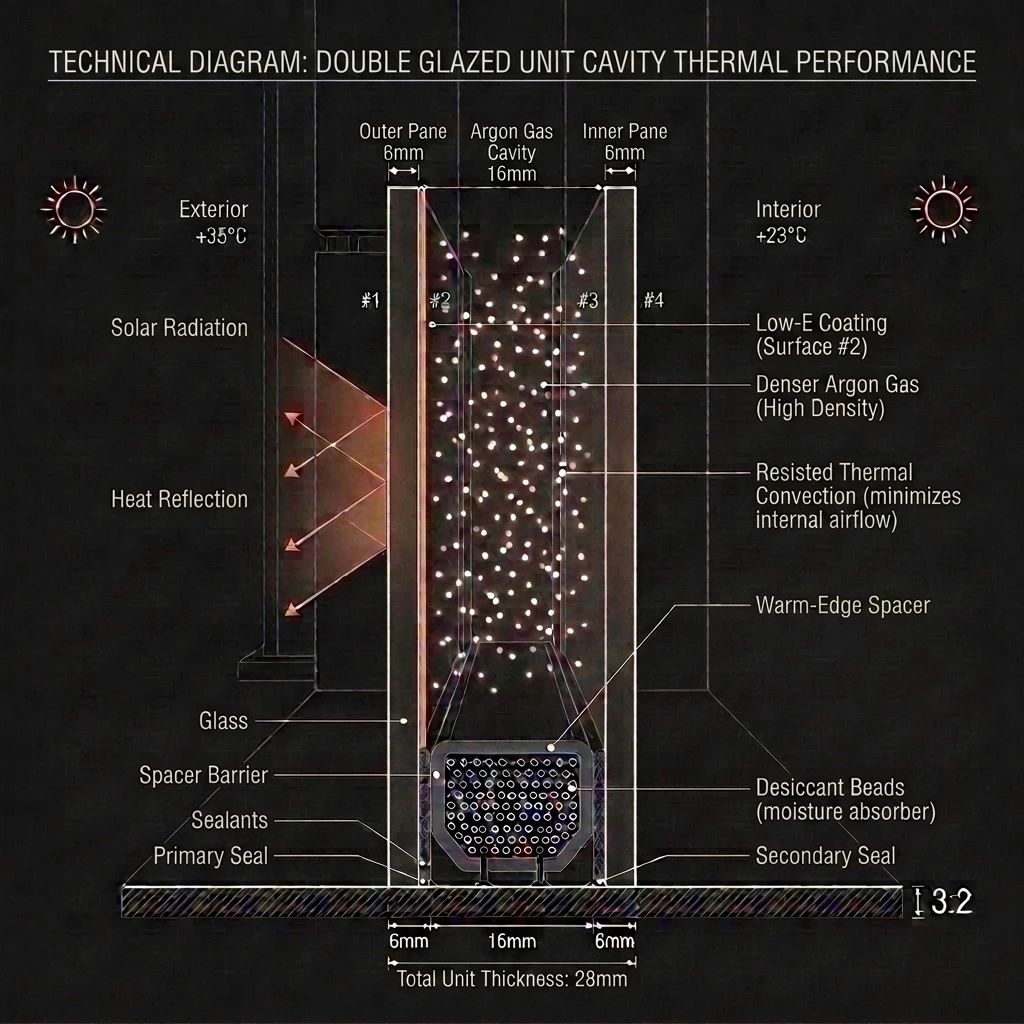
Argon is a noble gas: inert, non-toxic and invisible. The big difference from air? It's much denser. If ordinary air were the water of a river, argon would be a thick syrup.
That density makes argon far more "lazy" to move. When the relentless sun hits the outer pane, it heats up and tries to push the heat toward the inner pane. With the cavity filled with argon, that heat has an immense struggle to cross the space: the gas's convection movement plummets.
In practical terms, argon gas reduces the Ug (the glass's thermal transmittance) by about 0.35 W/m²K compared with dry air. Same window, same thickness, same look — just considerably higher efficiency, blocking the heat before it enters your living room.
What you actually feel day to day
You'll never see the argon. But you'll feel its work.
In practice, the inner face of the glass in your living room stays much closer to room temperature, even at the peak of summer. That means less heat radiating onto your furniture and, above all, the air conditioning working with far less effort to keep the house cool — exactly the gain that the window's thermal metric (the Uw value — the lower, the better) translates into a number. It's energy efficiency in its quietest form.
Thickness matters too (the other half of the equation)
The fill is only one side of the coin. The width of that gas cavity is the other.
A common mistake is thinking that putting argon in a giant cavity brings exponential benefit. In reality, the distance between the panes has a "sweet spot" (generally around 16 millimetres) — and that sweet spot even depends on the gas itself, since argon, being denser, has its optimum at a slightly different width from air. Beyond that, the advantage starts to be lost. We explain exactly why "wider isn't better" in the article on the geometry of the glass cavity.
The perfect seal
There's a vital detail many omit: argon only makes sense if it stays inside the glass.
In low-quality double glazing, the noble gas escapes through the edges within a few years. That's why, at Aken, the use of argon is tied to an excellent perimeter seal — and, often, to Warm Edge technology, which ensures the glass's seal matches the sophistication of the gas it carries.
Our approach inverts the market's logic: argon gas is the studio standard. Dry air remains a technical option for those who don't need an extreme thermal barrier — fully shaded façades, for example — or for those who want to optimise the project's investment intelligently, without ever giving up the perfect seal.
The "empty" space in your window doesn't have to be wasted. It can be your first line of defence against the heat.
The next step for your project
Understand the cavity's other variable: cavity width — why a bigger gap doesn't always insulate more.
Going beyond double glazing: double vs. triple glazing — when the third pane really pays off in Brazil.
Get to know the metric behind the heat: what the Uw value is and the physics of thermal insulation.
Frequently asked questions
What's the difference between double glazing with dry air and with argon gas?
Both fill the cavity between the glass panes. Dry air is 100% dehumidified air — the honest baseline, which prevents internal fogging and insulates well. Argon gas is the upgrade: a noble gas denser than air that hinders heat transfer and reduces the Ug (the glass's thermal transmittance) by about 0.35 W/m²K, without changing anything in its appearance.
Is it worth paying for argon gas in glass?
Yes, in most cases. Argon is one of the cheapest performance gains in the whole window: a small extra cost for a permanent, maintenance-free thermal improvement. The exception is fully shaded façades, where the extra thermal barrier against the sun matters less.
Does argon gas leak out of double glazing over time?
In low-quality double glazing, yes — the gas escapes through the edges within a few years and the benefit is lost. That's why argon only makes sense with an excellent perimeter seal, often paired with Warm Edge technology, which keeps the gas where it belongs.
Can double glazing fog up on the inside?
Only if it's poorly made. In a dry-air or argon cavity, the gas is 100% dehumidified and the spacer carries a desiccant salt that absorbs any residual moisture — so the cavity doesn't fog internally. Internal fogging is a sign of a broken seal, not of the design.
Technologies
- 1Tilt & Turn: the window that opens two ways (and why Brazil doesn't know it yet)
- 2Lift & Slide: the engineering behind monumental walls of glass
- 3Argon gas vs. dry air: what fills the glass cavity (and why it changes everything)
- 4Cavity width: why a 'wider' double-glazed unit doesn't always insulate more
- 5Double vs. triple glazing: when triple actually pays off in Brazil