
When analysing the technical spec of a high-end window, it's common to come across a discreet measurement that causes confusion: the thickness of the double-glazing cavity. You see options of 12 millimetres, 16, maybe 20 or even 24. The instinct of anyone used to the luxury market is to assume that, when it comes to insulation, the bigger number always wins.
But the physics of insulated glass hides a counter-intuitive limit. Beyond a certain point, paying for a wider cavity means, paradoxically, bringing less thermal comfort into your home.
It's not about maximising the space. It's about calibrating it.
The invisible work of the motionless gas
To understand why this limit exists, we need to look at the function of that gap. The premise of any double-glazed unit is elegant: to trap a hermetically sealed layer of gas between two panes of glass.
A perfectly motionless gas is a terrible conductor of heat. It's that stillness that creates your window's thermal shield, drastically reducing the air conditioning's workload on an afternoon of relentless sun. The performance of the glass unit itself is measured by Ug (the U of the glass); add the frame and it becomes the whole window's Uw value — in both, the lower, the better.
The efficiency of that shield depends on two variables. The first is what fills the space (our comparison of argon gas vs. dry air covers that). The second is exactly how wide that space is.
From 14 to 16mm: where intuition is right
At first, the popular intuition of "bigger is better" is correct.
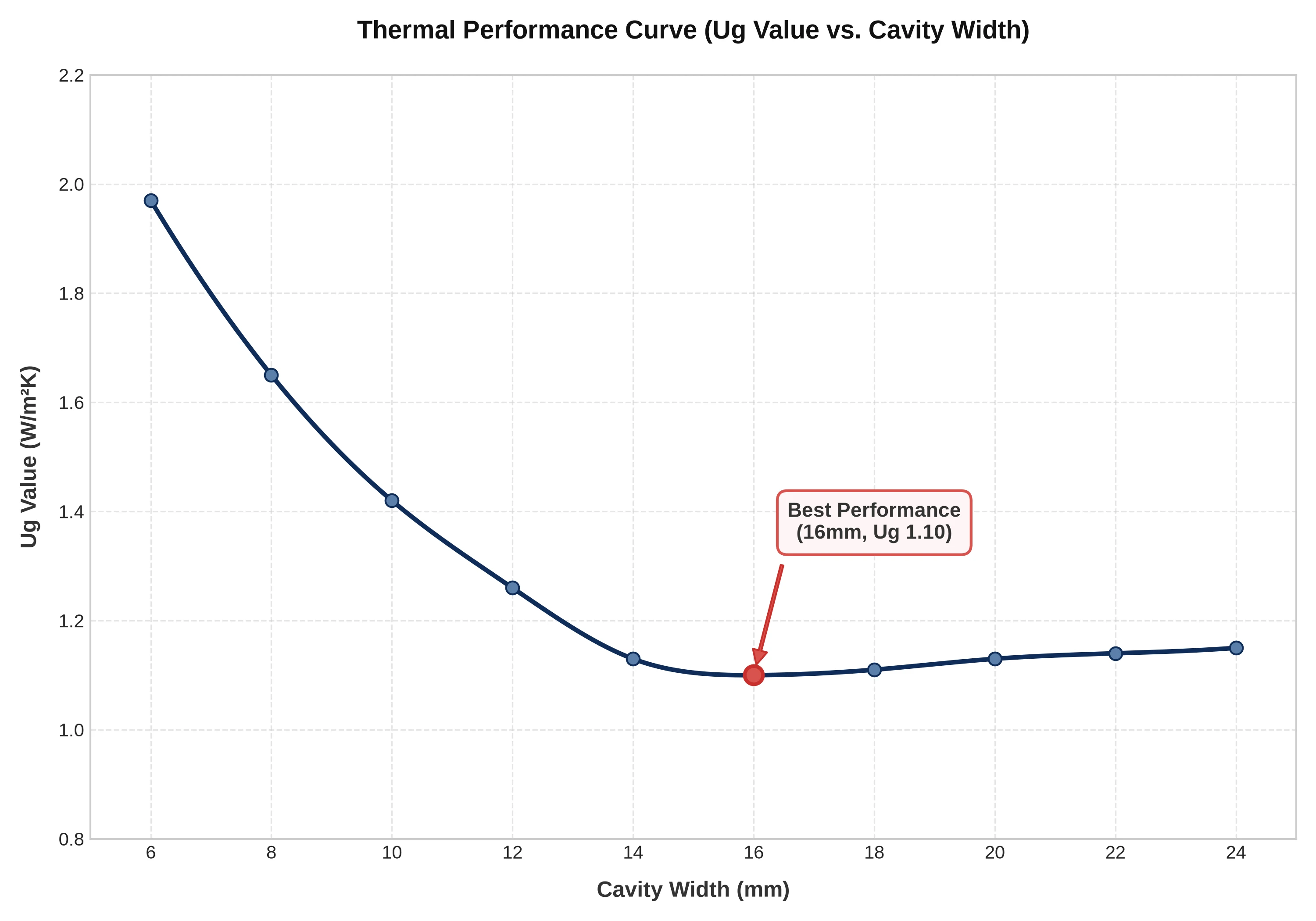
If the cavity is too narrow (6 or 8 millimetres), heat crosses from the outer pane to the inner one with relative ease, by pure conduction. As you move the two panes apart, the heat has a much longer, harder path to travel. Insulation improves.
That gain climbs fast, but slows as it nears the top — the last few millimetres return less and less. The real plateau, where the curve all but touches its best value, sits between 14 and 16 millimetres, peaking exactly at 16 mm. A 12 mm cavity is still on the steep part of the climb: it insulates noticeably worse than 16 mm and doesn't earn the "ideal" label. That's why the Studio standardises its cavities at 14 and 16 mm — the two widths genuinely on the plateau, without paying for thickness that doesn't turn into performance.
Up to here, physics works in your favour. The problem begins when you demand too much space.
The turning point: when the air wakes up
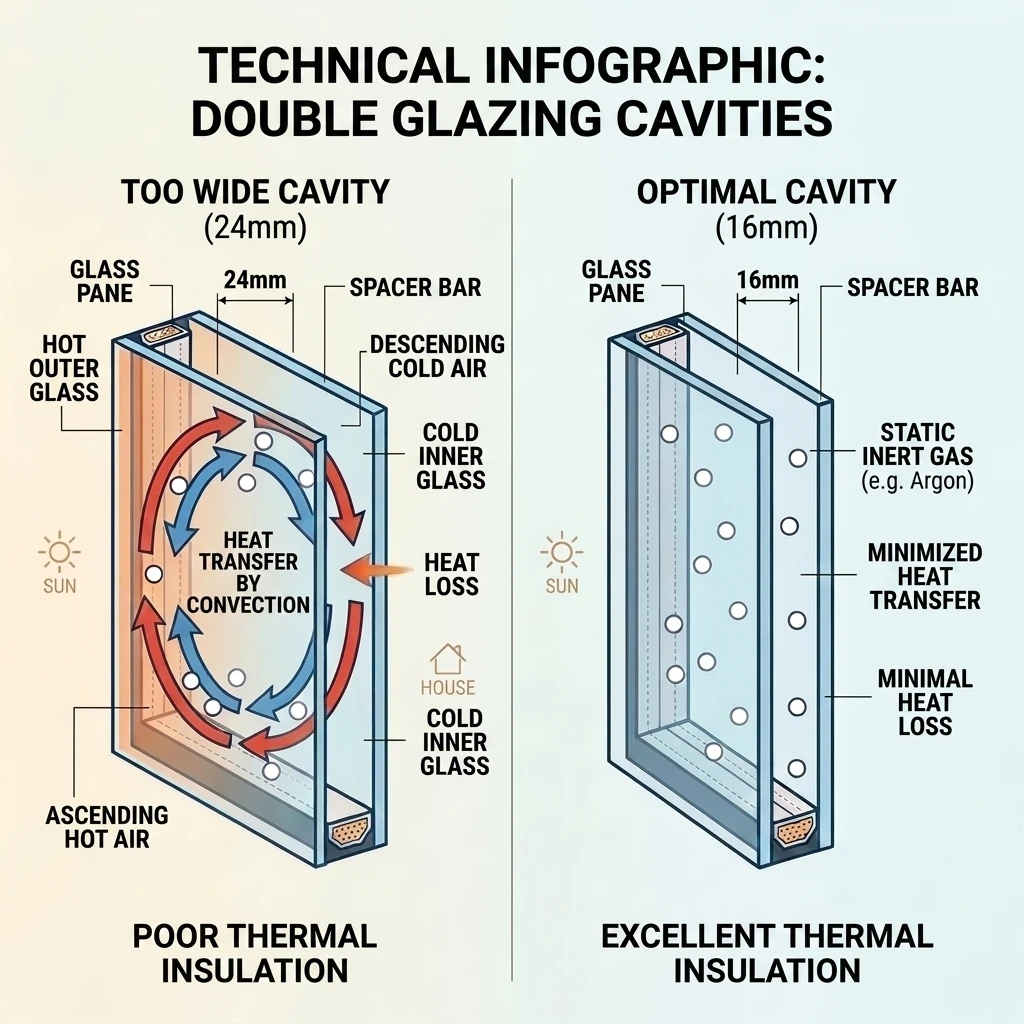
If the cavity gets too wide, physics flips the game. That gas which should be stagnant gains enough room to move.
Think of the real scenario: the sun hits the outer pane of the façade, which heats up quickly. The inner pane, facing the climate-controlled room, is cold. In a space wide enough (20 or 24 millimetres), that sharp temperature difference creates internal currents. The gas next to the hot pane rises; the gas next to the cold pane descends.
A cycle of thermal convection is born.
An invisible, continuous circulation forms inside your window, acting like a conveyor belt that actively steals heat from the outer pane and dumps it onto the inner one. The cavity "fattened up" so much that the very stillness that made it efficient was destroyed.
The fine-tuning with the gas
The exact millimetre at which the gas "wakes up" and begins to circulate isn't universal. It depends directly on the density of the substance used as the fill.
Noble gases are denser and heavier than ordinary air. Argon gas, the Aken studio's standard fill, is lazier to move — which means its performance peak obeys a slightly different millimetric calibration from air's. Even rarer gases (like krypton, used in extreme-cold climates) require even thinner cavities.
This leads us to a fundamental rule of façade engineering: the cavity width and the gas that fills it are two halves of the same equation. It's impossible to change one without throwing the other off balance.
Reading a quote like an engineer
In practice, this changes the way you evaluate your project's spec.
A window sold as "superior" just because it boasts a 24-millimetre cavity is, often, a commercial trap. Past the ideal point, that extra cavity may be delivering worse thermal insulation than a 16-millimetre version.
Worse still: it adds dead thickness and weight to the window, stealing design space and demanding more of the hardware when opening a monumental door.
At Aken, we don't inflate numbers to impress on paper. We size the spacer of each glass panel on the strict edge of cutting-edge physics: the width is tuned to the argon fill to extract the absolute limit of performance before convection can awaken — always anchored by our Warm Edge technology at the edges.
The "empty" space in your window doesn't need to be enormous to protect the room. It just needs to be exact.
The next step for your project
Understand the fill: argon gas vs. dry air — what's inside your window's glass.
Adding layers: double vs. triple glazing — when the third pane really pays off in Brazil.
The invisible seal against heat: Warm Edge and the end of condensation on windows.
Get to know the metric: what the Uw value is and the science of thermal insulation.
Frequently asked questions
What is the ideal cavity width for double glazing?
In most compositions, the peak of thermal insulation happens around 16 millimetres. Up to that point, moving the panes apart improves insulation; beyond it, the gas begins to circulate by convection and efficiency stalls or worsens. The exact value depends on the gas that fills the cavity.
Does a wider double-glazing cavity insulate more?
Only up to a point. Up to about 16 mm, a wider cavity hinders heat transfer and improves insulation. Beyond that, the gas gains room to form a convection loop that carries heat from one pane to the other — so a 24 mm cavity can insulate worse than a 16 mm one, and it weighs more too.
What does 16mm mean in double glazing?
It's the cavity width — the distance between the two panes of glass, occupied by the insulating gas (dry air or argon). 16 mm is usually the thermal sweet spot: enough separation to brake conduction, without so much space that the gas begins to circulate by convection.
Why does the ideal cavity depend on the gas?
Because convection starts earlier in light gases and later in dense ones. Ordinary air 'wakes up' and circulates in a narrower cavity; argon, denser and lazier, has its peak at a slightly different width. That's why width and gas are calibrated together, never in isolation.
Technologies
- 1Tilt & Turn: the window that opens two ways (and why Brazil doesn't know it yet)
- 2Lift & Slide: the engineering behind monumental walls of glass
- 3Argon gas vs. dry air: what fills the glass cavity (and why it changes everything)
- 4Cavity width: why a 'wider' double-glazed unit doesn't always insulate more
- 5Double vs. triple glazing: when triple actually pays off in Brazil