
In high-end architecture there's a natural instinct to assume that "more" is always "better". If double glazing delivers vastly superior performance to single glazing, then triple glazing must be the absolute pinnacle of comfort, right?
If you're building a cabin in the Swiss Alps, the answer is a categorical yes. In Europe, triple glazing has become the indispensable standard of good construction. But when we bring that same logic to the Brazilian climate, the maths of comfort changes drastically.
Across much of Brazil, paying for the third pane tends to be the perfectly right answer to the wrong problem. Knowing exactly when that extra layer is justified — and when it only adds weight and cost to the project — is the difference between buying a number on a spreadsheet and designing real comfort.
The anatomy of insulation: what you're buying
To understand the contest, we need to look at the composition of the material.
A double-glazed (insulated) unit is made of two panes separated by a sealed gas cavity. Triple glazing adds a third pane, creating two independent cavities. Each added cavity creates a new obstacle to the passage of heat — which improves the Ug, the glass's thermal insulation (the lower, the better), which in turn pulls down the whole window's Uw value.
To give a sense of scale: an ordinary double-glazed unit has a thermal-transfer index (Ug) around 2.7 W/m²K. Apply a smart solar-control coating and fill the cavity with argon gas, and that value plummets to an impressive 1.1 W/m²K. A high-performance triple goes further, reaching marks between 0.5 and 0.7 W/m²K.
The numbers are impressive. The challenge begins when we look at the balance of pros and cons.
The hidden cost of the third pane
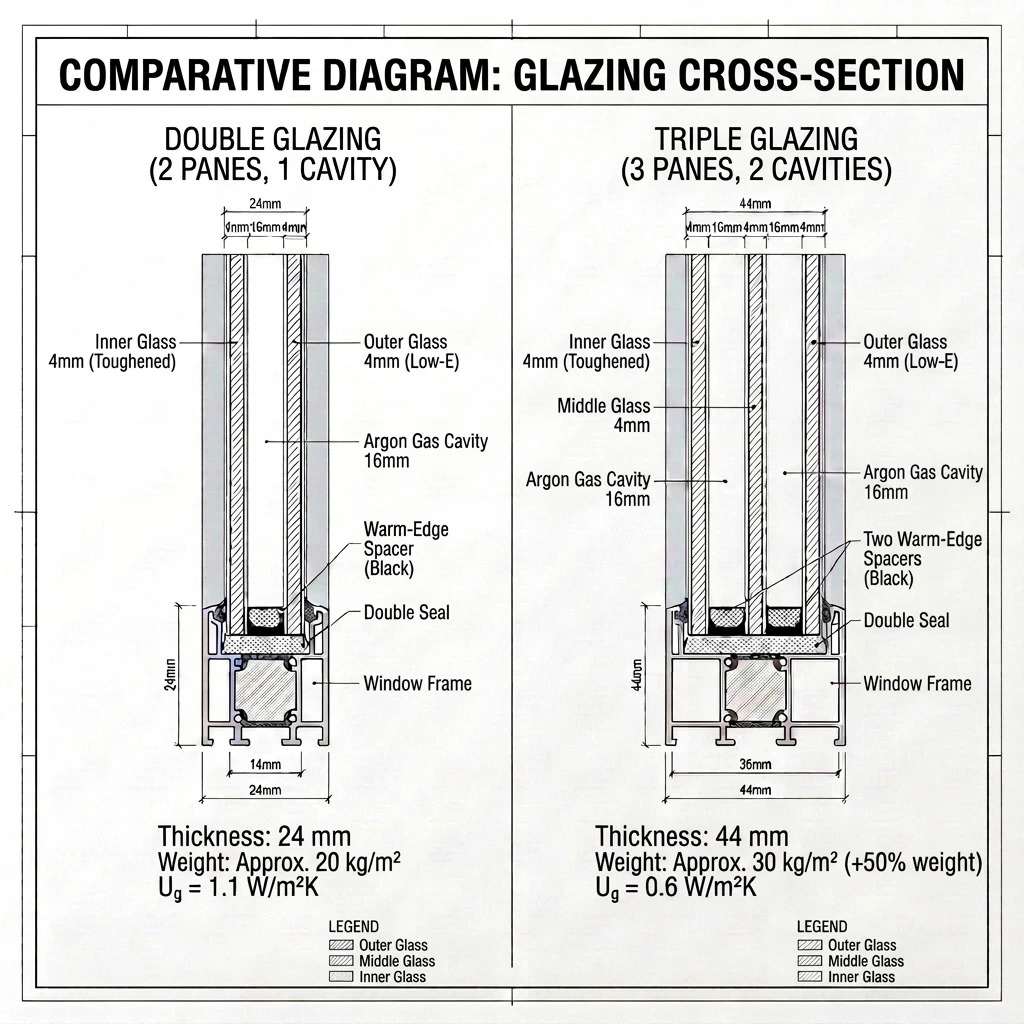
The third pane charges a price that goes beyond the financial.
First, the weight. Glass is a dense material. Adding 30% to 50% of weight to every door in the house demands sturdier aluminium profiles and far more robust hardware for the window to keep operating smoothly — one of the reasons we use Lift & Slide technology for large spans.
Second, the light. Each extra layer the sunlight has to cross causes a small loss. Triple glazing, by nature, subtly reduces the transmission of natural light into the room compared with a crystal-clear double.
All of this is worth it if you need to fight the enemy triple glazing was invented for: the conduction of extreme cold.
The Brazilian climate flips the priority
Here we reach the technical turning point. Triple glazing's superpower is stopping the heat of the fireplace or heater from escaping into the freezing winter air outside. It's a war of thermal conduction.
But in Brazil the dominant villain is another. The greatest load on your air conditioning on a January afternoon isn't the heat conducted through the air — it's the direct solar radiation scorching the west façade.
Against the radiation of the intense sun, the number of panes isn't the deciding factor. What really blocks the "greenhouse heat" is the solar factor (g value) — the invisible protection applied to the glass surface (the so-called selective or Low-E glass). We detail that lever in the article on solar control.
That's why, for a high-end apartment in Rio, São Paulo or the Northeast, a smart double-glazed unit (with the exact solar protection for that façade and filled with argon gas) blocks the sun's heat far more efficiently, with less weight and lower cost, than a plain triple.
The third pane doesn't replace the thermal design.
When triple really pays off in Brazil
Does that mean triple glazing has no place here? On the contrary. It's an extraordinary engineering tool — as long as it's applied to the right problem. At Aken, we recommend it in these scenarios:
- Absolute sound blocking. Sound hates mass and hates asymmetry. For studios, projects right on heavy-traffic avenues, flight paths, or clients who demand extreme acoustic insulation (Rw index), a triple with asymmetric acoustic-laminated panes creates a virtually impenetrable sound barrier. (We go deeper in the article on the acoustic window system.)
- Genuinely cold regions. If the project is in a mountain region or other cold areas where winter is harsh, the third pane returns to its original specialty.
- Extreme projects and certification. Homes designed under the rigorous metrics of Passive House, where every tenth of a W/m²K is counted to do away with active heating or cooling, often require triple panels.
How to design for real — the Aken approach
The worst way to specify luxury windows is to apply the same recipe to every opening in the house.
At Aken, we don't try to "sell more panes". We size the system. The west façade, which fries in the afternoon sun, may demand a relentless selective double. The main bedroom facing the noisy street may call for the silence of an asymmetric triple. The shaded back living room may use a crystal-clear double with dry air.
Luxury isn't buying the product with the biggest number on the spec sheet. Luxury is having the exact technology, tuned to protect your space, window by window.
The next step for your project
The smartest double-glazing upgrade: argon gas vs. dry air — what's inside the glass.
Protecting yourself from the Brazilian sun: the solar factor and the end of the greenhouse effect at home.
Real acoustic insulation: how triple glazing and asymmetry create absolute silence.
European certification in Brazil: what a Passive House is.
Frequently asked questions
Is triple glazing worth it in Brazil?
Not always. Triple glazing was created to fight the intense cold of the European winter, and at that it's unbeatable. But across much of Brazil the villain is the sun, not the cold — and against solar radiation a well-specified double-glazed unit (with the right Low-E coating and argon gas) usually blocks heat better, with less weight and lower cost, than a plain triple.
What's the difference between double and triple glazing?
Double glazing has two panes separated by one gas cavity; triple has three panes and two cavities. Each extra cavity hinders heat transfer by conduction, improving the glass's thermal insulation (the Ug, which pulls down the window's Uw value). In exchange, triple weighs more, costs more and lets through a little less natural light.
When does triple glazing really pay off?
In three scenarios: extreme acoustic insulation (heavy-traffic avenues, flight paths — ideally with asymmetric laminated panes), genuinely cold microclimates (mountain regions, altitude) and certification projects like Passive House, where every tenth of a W/m²K counts. Beyond that, a smart double usually solves it.
Does triple glazing insulate more than double glazing?
Against conducted heat and cold, yes: more cavities mean a lower Ug (and therefore a lower Uw). But against direct solar radiation — the dominant problem across most of Brazil — what decides isn't the number of panes, but the solar factor (the Low-E solar-control layer). A selective double can protect from the sun better than an untreated triple.
Technologies
- 1Tilt & Turn: the window that opens two ways (and why Brazil doesn't know it yet)
- 2Lift & Slide: the engineering behind monumental walls of glass
- 3Argon gas vs. dry air: what fills the glass cavity (and why it changes everything)
- 4Cavity width: why a 'wider' double-glazed unit doesn't always insulate more
- 5Double vs. triple glazing: when triple actually pays off in Brazil