
Turn the handle 90 degrees and the entire window swings inward, exactly like a door. Turn it upward and the top of the window tilts inward, opening a subtle gap up high. A single handle, two completely different windows.
In Europe, this is the rule. It's the window you find from Lisbon to Helsinki, designed to deliver thermal comfort, silence and versatility in one system. In Brazil, however, most people have never seen one.
The national market spent decades standardising sliding and awning windows — not because they were the most efficient options, but out of habit and cost. The result is that we grew used to windows that whistle in the wind, let street noise in and let the air conditioning escape. The Tilt & Turn window turns that logic on its head. With a single lever it does what the ordinary Brazilian window simply cannot.
And the secret isn't only in how it opens. It's mainly in how it closes.
The engineering behind a single handle
The intelligence of the Tilt & Turn system lies in its dual-axis hardware. Hidden in the perimeter of the sash, a piece of precision machinery links the handle to a set of hinges and locks. The intuition is simple; the engineering is refined.
When you operate the lever, you're not just releasing a latch. You're reconfiguring the window's pivot points in real time — deciding, with a single gesture, which axis it will move on.
These two positions don't exist to impress. They solve real, everyday problems, each in its own way.
The "tilt" position: smart, secure ventilation
Picture a muggy summer afternoon. You want to refresh the living room, but leaving a sliding window open means inviting the late-afternoon rain in — and leaving the house vulnerable.
By turning the handle upward, the window enters the tilt position. The top of the sash leans into the room by about 10 to 15 centimetres, while the base stays locked in the frame.
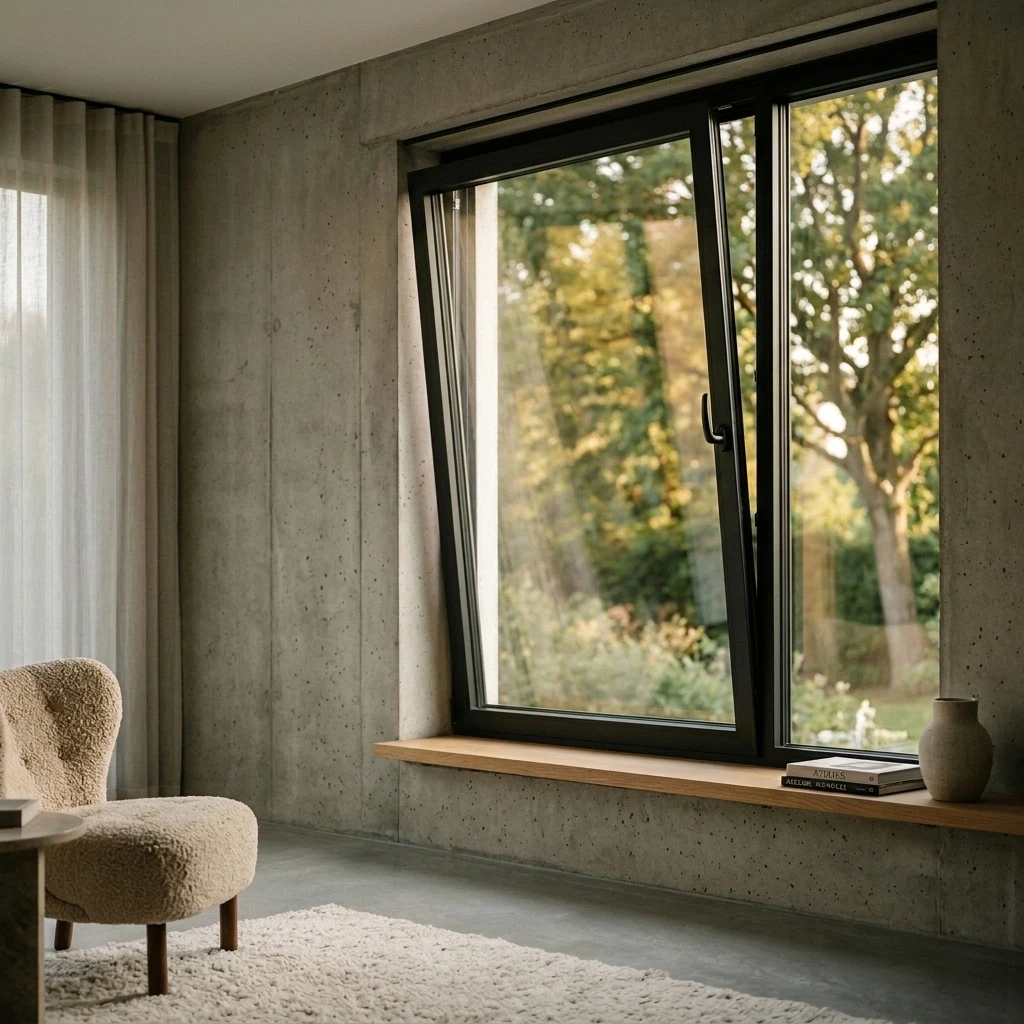
What do you gain? Ventilation with no compromises. Fresh air comes in from above and mixes with the room's air before descending, creating a gentle, continuous circulation — without that direct, unpleasant draught in your face. If it rains, the angle of the glass sends the water outward. If it blows hard, no doors slam, because the sash is rigidly anchored.
It's the perfect solution for night-time ventilation. You sleep with the house breathing, knowing the opening is too narrow to allow break-ins and that the window stays mechanically locked. A fundamentally superior way to air out a room than leaving an ordinary window half open.
The "turn" position: full access and risk-free maintenance
Turn the handle to horizontal and the axis changes. Now the window releases from the top and pivots on the side hinges, opening fully into the room.
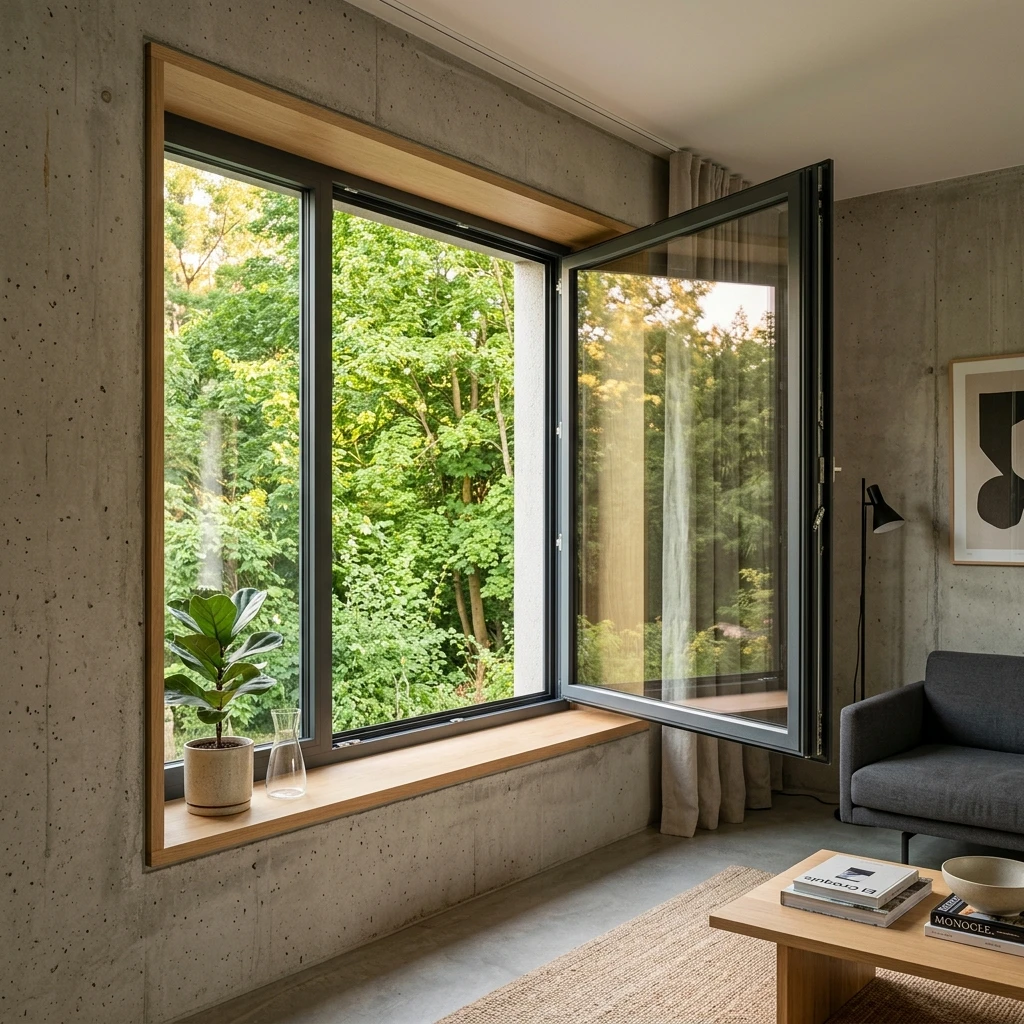
The immediate advantage is the sheer width: a full clear opening connecting inside to outside, even serving as an escape route in emergencies. But the real everyday trump card is ease of maintenance.
Think of the reality of living in an apartment on the 12th floor. Cleaning the outside of an ordinary sliding window means balancing dangerously out over the façade — or hiring a specialist company. With the Tilt & Turn system, the outside comes to you. You clean the outer glass standing up, safely, from inside your own living room. What used to be a risky operation becomes trivial.
The invisible secret: the geometry of the perfect seal
The versatility of opening two ways is what charms at first sight. But the real reason Tilt & Turn technology is the European standard — and why high-end projects in Brazil demand it — is what happens when the window is closed.
To slide, a sliding window needs clearance in its tracks. It runs alongside its own seals, brushing over them. That need for friction-based movement means it never seals tight: there are always tiny invisible gaps. And wherever air passes, so does the sound of the avenue, and out goes the cool of the air conditioning.
The Tilt & Turn window eliminates that geometric flaw.
When you lower the handle to lock, the locking rollers distributed around the entire perimeter of the sash don't just click into place — they act like small levers that pull the window against the frame. The sash is pressed evenly against the weatherstripping (the gaskets).
The result is a hermetic seal, much like the door of a luxury car.
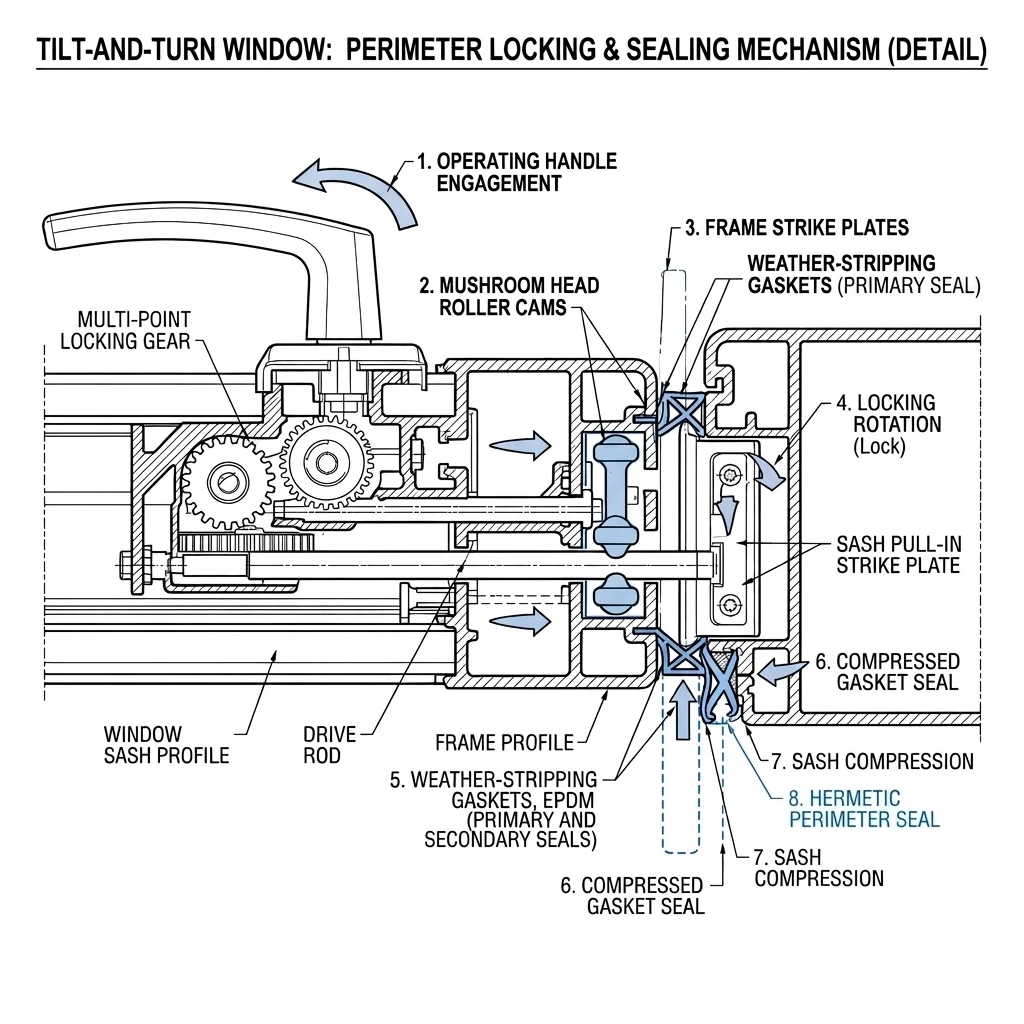
It's this mechanical compression that lets the window block water even under extreme wind-driven rain. It's what creates the barrier against urban chaos, raising the acoustic insulation (the Rw index) to levels sliding windows can't reach. And it's what stops unwanted heat exchange, keeping the room at the right temperature and driving down the cost of climate control (an optimised Uw value — the lower the Uw, the better the thermal insulation).
Excellent acoustics and thermal performance are not magic; they're the result of a geometry that allows total sealing. And the foundation of that geometry is Tilt & Turn.
Why Brazil hasn't adopted it yet (and why that's changing)
Brazil's distance from this technology was a matter of industrial convenience. The plain aluminium slider, with ordinary 4 mm glass, became the norm because it's easy to mass-produce, cheap, and doesn't take up interior space when opened. We accepted the roar of the motorbike outside, the puddle on the sill after the storm, and the loss of air-conditioning efficiency as "facts of life".
But contemporary high-end Brazilian architecture has stopped accepting those compromises.
It makes no sense to design a residential oasis and leave it vulnerable to climate and noise precisely at its openings. The demand for real, measurable, continuous comfort brought the need for superior technologies. Aken doesn't see the Tilt & Turn system as an imported luxury, but as the minimum technical standard for anyone who wants the window to work as an active shield for the home.
The technology as part of a system
Brilliant hardware in a poor profile loses its purpose. For Tilt & Turn technology to deliver the silence and insulation it promises, it can't act alone.
Aken builds its Tilt & Turn windows by pairing that perimeter-precision hardware with aluminium profiles featuring a Thermal Break (thermal break) and compositions of ultra-high-performance double glazing. It's the sum of the parts: the opening geometry guarantees the seal, the profile blocks heat conduction, and the glass finishes the insulation. The mechanism keeps its promise because the ecosystem around it was designed for that.
A single handle, two ways to open — and the hermetic seal that makes everything else possible.
The next step for your project
Discover the sibling technology for monumental spans: the engineering behind Lift & Slide.
Understand how the hermetic seal transforms the temperature of the home: what the Uw value is (thermal insulation).
Not sure which model to use? Read our buying guide: the art of choosing the right window.
Frequently asked questions
What is a Tilt & Turn window?
It's a window with dual-axis hardware operated by a single handle: turn it 90 degrees and the sash swings fully inward, like a door; turn it up and only the top tilts inward, for secure ventilation. When closed, it is pressed against the frame and seals hermetically.
What's the difference between a Tilt & Turn window and a sliding window?
A sliding window glides on tracks and therefore needs clearance: it never seals completely, letting air, noise and heat pass. A Tilt & Turn doesn't slide — when you lock it, rollers all around the perimeter pull the sash against the weatherstripping, creating a hermetic seal that a slider can't achieve.
What does the tilt position of the window mean?
In the tilt position, the top of the sash leans inward by about 10 to 15 cm while the base stays locked in the frame. This ventilates the room continuously and gently, keeps the rain outside, and leaves the opening too narrow for break-ins — ideal for sleeping with the house aired out.
Why is the Tilt & Turn window rare in Brazil?
Out of industrial convenience: the plain aluminium slider is cheap, easy to mass-produce and doesn't take up interior space when opened, so it became the national standard. The Tilt & Turn is the European standard precisely because of performance — and high-end Brazilian architecture has come to demand it for the acoustic and thermal comfort only it delivers.
Technologies
- 1Tilt & Turn: the window that opens two ways (and why Brazil doesn't know it yet)
- 2Lift & Slide: the engineering behind monumental walls of glass
- 3Argon gas vs. dry air: what fills the glass cavity (and why it changes everything)
- 4Cavity width: why a 'wider' double-glazed unit doesn't always insulate more
- 5Double vs. triple glazing: when triple actually pays off in Brazil